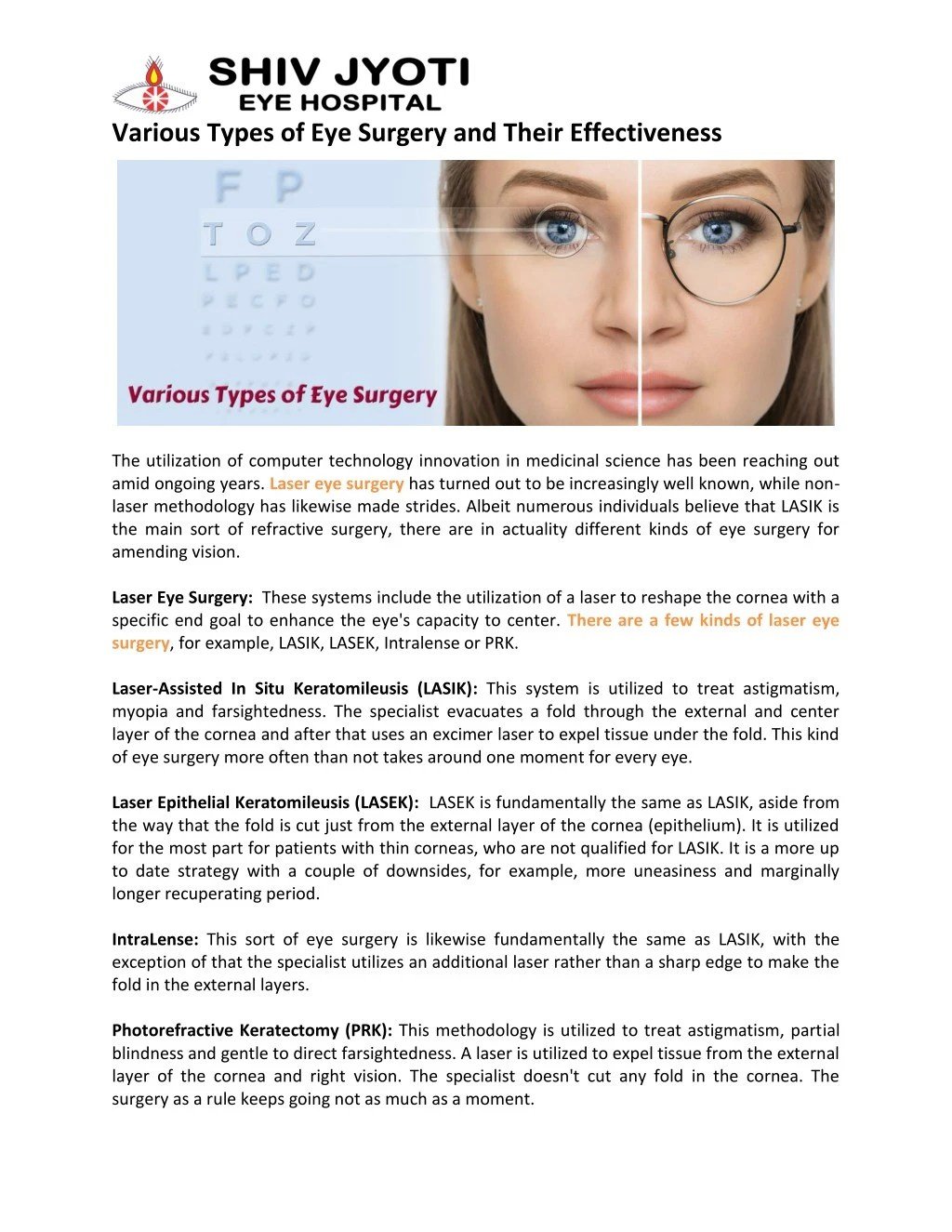
Contemplating a life free from glasses and contact lenses? Laser eye surgery has transformed the way millions experience the world, offering a pathway to clearer vision. But with a growing array of advanced procedures, understanding the Types of Laser Eye Surgery and Eligibility for each can feel like navigating a complex maze. Don't worry, we're here to cut through the jargon and provide a comprehensive, human-first guide to help you find your ideal path to visual freedom.
At a Glance: Your Laser Eye Surgery Checklist
- LASIK, PRK, and SMILE are the most common refractive surgeries, primarily correcting myopia, hyperopia, and astigmatism.
- Eligibility is personal: Factors like corneal thickness, prescription stability, age, and overall eye health dictate which procedure is suitable.
- Advanced options like Contoura Vision and Wavefront-guided LASIK offer even greater precision for specific visual challenges.
- Lens-based surgeries (RLE, IOL) are alternatives for those not eligible for corneal reshaping, often for higher prescriptions or age-related vision changes.
- Therapeutic lasers (PRP, SLT) treat eye diseases like glaucoma or diabetic retinopathy, distinct from vision correction.
- A detailed eye exam by a refractive surgeon is the only way to confirm your eligibility and recommend the best procedure for your eyes.
Understanding the Landscape of Laser Vision Correction
Laser technology has revolutionized ophthalmology, allowing surgeons to precisely reshape the eye's cornea or replace its natural lens to correct refractive errors. These errors—nearsightedness (myopia), farsightedness (hyperopia), and astigmatism—occur when the eye doesn't focus light correctly onto the retina, leading to blurry vision. By altering the eye's focusing power, these procedures aim to reduce or eliminate your dependence on corrective eyewear.
It's a field that continues to innovate, offering increasingly personalized and effective solutions. While the goal is generally clearer vision, the 'how' varies significantly between procedures, and understanding these differences is key to identifying your best fit.
The Big Players: Common Laser Eye Surgeries and Who They're For
Let's dive into the core types of laser eye surgery, detailing how they work and, crucially, who typically makes a good candidate.
1. LASIK (Laser-Assisted In Situ Keratomileusis): The Gold Standard for Many
What it is: LASIK is arguably the most well-known and frequently performed laser eye surgery. It's a quick, highly effective procedure designed to correct common refractive errors.
How it works: Imagine your cornea as the eye's clear, outermost "window." In LASIK, a femtosecond laser precisely creates a thin, hinged flap on the surface of your cornea. This flap is gently lifted, and then an excimer laser reshapes the underlying corneal tissue to correct your vision prescription. Once reshaped, the flap is carefully repositioned, where it naturally adheres without stitches.
Conditions Treated:
- Nearsightedness (myopia)
- Farsightedness (hyperopia)
- Astigmatism
Why people choose it: Many opt for LASIK to dramatically improve their eyesight and reduce reliance on glasses or contact lenses. The procedure is famously fast, and vision often improves within 24 hours.
Who is a good candidate (Eligibility): - Individuals with mild to severe myopia, mild to moderate hyperopia, or astigmatism.
- You must have adequate corneal thickness to allow for flap creation and sufficient remaining tissue after reshaping.
- A stable glasses or contact lens prescription for at least a year.
- Generally aged 18 or older, with healthy eyes free from disease.
Advantages: - Quick procedure (often 10-15 minutes per eye).
- Minimal discomfort during and after surgery.
- Rapid visual recovery (often next day).
- Highly accurate and safe with a high success rate.
Disadvantages: - Not suitable for very thin corneas.
- Rare flap-related complications are possible.
- May temporarily worsen dry eye symptoms in some patients.
2. PRK (Photorefractive Keratectomy) / ASA (Advanced Surface Ablation): The Flap-Free Foundation
What it is: PRK, often referred to as Advanced Surface Ablation (ASA), is one of the earliest forms of laser eye surgery and remains a popular choice, particularly for those not suited for LASIK.
How it works: Unlike LASIK, PRK doesn't involve creating a corneal flap. Instead, the surgeon gently removes the outermost layer of the cornea, called the epithelium. This layer is very thin and regenerates naturally. Once the epithelium is removed, an excimer laser reshapes the underlying corneal tissue. A special bandage contact lens is then placed over the eye to protect it during the initial healing process, typically for 3-5 days.
Conditions Treated:
- Nearsightedness (myopia)
- Farsightedness (hyperopia)
- Astigmatism
Why people choose it: PRK is a robust option for individuals concerned about flap-related complications or those with active lifestyles.
Who is a good candidate (Eligibility): - Patients aged 18 to 60 with stable prescriptions.
- Ideal for individuals with thin corneas, which may preclude LASIK.
- Those with mild to moderate refractive errors.
- Active individuals like athletes or military personnel who face a higher risk of eye injury, where a corneal flap could be problematic.
- People prone to dry eyes.
Advantages: - No corneal flap, eliminating flap-related risks.
- Excellent long-term visual outcomes, comparable to LASIK.
- Suitable for individuals with thin corneas or certain corneal irregularities.
Disadvantages: - Longer recovery period (up to 1-2 weeks) compared to LASIK.
- Temporary discomfort, light sensitivity, and blurry vision are common during the initial healing phase.
- Requires more post-operative care with eye drops.
3. SMILE (Small Incision Lenticule Extraction): Minimally Invasive, Highly Effective
What it is: SMILE is a newer, minimally invasive refractive surgery that's quickly gaining popularity as an alternative to LASIK and PRK.
How it works: A femtosecond laser creates a tiny, disc-shaped piece of corneal tissue (called a lenticule) inside the cornea. The surgeon then removes this lenticule through a very small incision (2-4 mm) on the corneal surface. By removing the lenticule, the cornea's shape is subtly altered, correcting the refractive error without creating a large flap.
Conditions Treated:
- Nearsightedness (myopia)
- Astigmatism (within specific ranges)
Why people choose it: Its minimal incision and flap-free nature are appealing to many, particularly those concerned about dry eyes or seeking a quick return to activity.
Who is a good candidate (Eligibility): - Individuals aged 18 to 60 with stable prescriptions.
- Suitable for mild to severe myopia and astigmatism.
- Patients with dry eyes, as the procedure is thought to preserve more corneal nerves responsible for tear production.
- Those with active lifestyles who prefer a flap-free procedure.
Advantages: - No corneal flap, significantly reducing flap-related complications.
- Very small incision, which may reduce the risk of post-operative dry eye.
- Quick visual recovery with minimal discomfort.
- Suitable for certain patients with thin corneas who might not qualify for LASIK.
Disadvantages: - Currently not suitable for hyperopia (farsightedness).
- Limited treatable range for astigmatism compared to LASIK.
- Less widespread availability than LASIK or PRK.
4. LASEK (Laser-Assisted Subepithelial Keratomileusis): A Specialized Alternative
What it is: LASEK is another surface ablation technique, similar to PRK, often chosen for patients with specific corneal characteristics.
How it works: Instead of removing the epithelial layer entirely, LASEK uses a diluted alcohol solution to loosen and lift the epithelial layer as a very thin flap. The excimer laser then reshapes the underlying cornea, and the epithelial flap is carefully repositioned. A bandage contact lens is typically applied to aid healing.
Conditions Treated:
- Nearsightedness (myopia)
- Farsightedness (hyperopia)
- Astigmatism
Why people choose it: It offers a flap-free solution suitable for complex cases where LASIK might be contraindicated.
Who is a good candidate (Eligibility): - Patients with thin corneas or asymmetric corneal topographies.
- Individuals involved in combat sports or high-risk occupations where corneal flap integrity is a concern.
- Those not suitable for LASIK due to specific corneal characteristics.
Advantages: - No deep corneal flap, reducing associated complications.
- Reduced risk of exacerbating dry eye symptoms.
- Suitable for a broader range of complex cases.
Disadvantages: - Slightly longer healing time than LASIK.
- Can involve more initial discomfort than LASIK.
Beyond the Basics: Advanced LASIK & Refractive Innovations
The field of laser eye surgery is always evolving. Several advanced variations offer greater precision and customization, targeting specific visual imperfections beyond just your basic prescription.
5. Contoura Vision LASIK (Topography-Guided LASIK): The Personalized Perfectionist
What it is: Contoura Vision is a highly advanced version of LASIK that uses ultra-detailed corneal mapping technology to create a truly personalized treatment plan.
How it works: Imagine a fingerprint for your eye. A sophisticated device maps up to 22,000 unique points on the cornea, identifying microscopic irregularities that standard LASIK might miss. The excimer laser then uses this ultra-precise 3D map to smooth out these imperfections, resulting in a cornea that is not only shaped for optimal focus but also optically smoother.
Conditions Treated:
- Nearsightedness (myopia)
- Astigmatism
- Irregular corneas
Why people choose it: Patients often seek Contoura Vision for the potential to achieve vision better than 20/20, along with a significant reduction in visual disturbances like glare and halos, especially at night.
Who is a good candidate (Eligibility): - Individuals with irregular corneas or high astigmatism.
- Those seeking the sharpest, most "HD-quality" vision possible.
- Patients who experience night vision issues, glare, or halos with their current glasses/contacts.
- Requires adequate corneal thickness, similar to standard LASIK.
Advantages: - Potentially delivers visual outcomes superior to 20/20.
- Significantly reduces symptoms like glare, halos, starbursts, and difficulty with night vision.
- Highly customized treatment tailored to your eye's unique structure.
Disadvantages: - Generally higher cost than standard LASIK.
- Not suitable for very severe irregularities or extremely thin corneas.
6. Wavefront-Guided LASIK: Sharper Night Vision, Tailored Results
What it is: Wavefront-guided LASIK is a customized procedure designed to correct not only your basic prescription but also higher-order aberrations (HOAs)—subtle optical imperfections that can affect visual quality, especially in low light.
How it works: A wavefront analyzer measures how light travels through your entire eye, creating a unique "optical map" of these higher-order aberrations. The excimer laser then uses this detailed map to make highly precise adjustments to the cornea, addressing these minute irregularities.
Conditions Treated:
- Nearsightedness (myopia)
- Farsightedness (hyperopia)
- Astigmatism
- Higher-order aberrations (e.g., spherical aberration, coma, trefoil)
Why people choose it: Patients with specific complaints about night vision, glare, or starbursts often find this option appealing, as it offers a more personalized correction than traditional LASIK.
Who is a good candidate (Eligibility): - Individuals experiencing night-time glare, halos, or other visual distortions.
- Patients with mild to moderate refractive errors.
- Those seeking enhanced visual clarity and a reduction in HOAs.
- Requires stable refractive power and healthy eyes.
Advantages: - Can improve contrast sensitivity and reduce night vision disturbances.
- More personalized correction than traditional LASIK.
- Often results in sharper, clearer vision.
Disadvantages: - Higher cost than standard LASIK.
- May not be beneficial for everyone, as not all patients have significant HOAs.
7. Wavefront-Optimized LASIK: Preserving Natural Eye Shape
What it is: Wavefront-optimized LASIK is a variation that aims to maintain the natural, prolate shape of the cornea during the reshaping process, thereby reducing induced optical aberrations.
How it works: While it doesn't correct specific higher-order aberrations like wavefront-guided LASIK, it strategically applies the laser energy to ensure the cornea retains its natural curvature. This prevents the creation of new spherical aberrations that can sometimes occur with traditional LASIK, where the peripheral cornea might become flatter.
Conditions Treated:
- Nearsightedness (myopia)
- Farsightedness (hyperopia)
- Astigmatism
Why people choose it: This method is often chosen for its ability to provide excellent visual outcomes while proactively minimizing the risk of post-operative glare and halos by preserving the eye's natural optics.
Who is a good candidate (Eligibility): - Individuals with mild to severe myopia, hyperopia, and astigmatism.
- Those who want enhanced sharpness and clarity, with a lower risk of post-operative spherical aberrations.
- Patients who might not qualify for wavefront-guided LASIK but still seek an advanced treatment.
Advantages: - Lower risk of inducing new glare or halo effects compared to older LASIK techniques.
- Good for a wide range of prescriptions.
- Often leads to quicker healing and visual recovery.
Disadvantages: - Less personalized in correcting existing higher-order aberrations than wavefront-guided LASIK.
8. Epi-LASIK (Epithelial Laser In Situ Keratomileusis): Gentler for Delicate Corneas
What it is: Epi-LASIK is a variation of PRK, offering a surface ablation technique that aims for a gentler removal of the corneal epithelium.
How it works: Instead of using an alcohol solution (like LASEK) or simply scraping (like traditional PRK), Epi-LASIK employs a specialized blunt instrument, an "epikeratome," to separate the epithelial layer. This layer can sometimes be preserved and repositioned, though it often regenerates naturally, similar to PRK. The underlying cornea is then reshaped with an excimer laser.
Conditions Treated:
- Nearsightedness (myopia)
- Farsightedness (hyperopia)
- Astigmatism
Why people choose it: It's an excellent choice for individuals with delicate or thin corneas, or those whose professions carry a high risk of eye injury.
Who is a good candidate (Eligibility): - Patients with thin corneas, making them unsuitable for LASIK.
- Individuals with mild dry eyes.
- People involved in contact sports or military personnel who require a flap-free procedure.
Advantages: - No corneal flap, eliminating flap-related risks.
- Generally less discomfort than traditional PRK.
- Suitable for military personnel and athletes due to the absence of a flap.
Disadvantages: - Longer visual recovery time than LASIK or SMILE.
- Temporary corneal haze can occur in some cases, though less common than PRK.
9. ReLEx SMILE PRO: The Next Evolution of SMILE
What it is: SMILE Pro is the latest advancement in small-incision lenticule extraction (SMILE) technology, building upon the established benefits of standard SMILE.
How it works: Using a next-generation femtosecond laser (often the ZEISS VisuMax 800), SMILE Pro performs the lenticule creation and extraction even faster and with enhanced precision. The mechanism is similar to standard SMILE—a lenticule is created inside the cornea and removed through a tiny incision—but the procedure time is significantly reduced.
Conditions Treated:
- High nearsightedness (myopia)
- Astigmatism
Why people choose it: Patients seeking the quickest, most comfortable, and technologically advanced flap-free option, especially those with high prescriptions or active lifestyles.
Who is a good candidate (Eligibility): - Individuals with stable high myopia and astigmatism.
- Active individuals who prioritize minimal downtime and a quick return to routine.
- Those seeking the benefits of SMILE with even greater speed and precision.
- Requires similar corneal health and stability as standard SMILE.
Advantages: - Significantly shorter procedure time (often less than 10 seconds per eye for laser application).
- Enhanced visual outcomes due to improved laser technology.
- Even smaller incision than standard SMILE, potentially leading to faster healing.
- All the benefits of standard SMILE (flap-free, reduced dry eye risk).
Disadvantages: - Limited availability in some regions due to its newness.
- Higher cost compared to standard SMILE or LASIK.
- Still not suitable for hyperopia.
When Lasers Reshape More Than Just Vision: Lens-Based & Therapeutic Procedures
Sometimes, simply reshaping the cornea isn't enough, or isn't the best option. For certain conditions, particularly higher prescriptions or age-related changes, procedures involving the eye's natural lens, or even therapeutic lasers to treat disease, come into play.
10. RLE (Refractive Lens Exchange) / CLE (Clear Lens Extraction): Exchanging Your Lens for Clarity
What it is: RLE, also known as CLE, is a surgical procedure that involves replacing your eye's natural lens with an artificial intraocular lens (IOL). It's essentially cataract surgery performed before a cataract develops.
How it works: The surgeon makes a tiny incision at the edge of the cornea, removes your natural lens (which might not yet be cloudy like a cataract), and inserts a silicone or plastic intraocular lens tailored to your prescription. This new lens provides clear vision at various distances, depending on the type of IOL chosen (e.g., monofocal, multifocal, extended depth of focus).
Conditions Corrected:
- High nearsightedness (myopia)
- High farsightedness (hyperopia)
- Astigmatism
- Presbyopia (age-related loss of near vision)
- Often a solution for those with thin corneas or severe dry eyes who are not good candidates for corneal laser surgery.
Who is a good candidate (Eligibility): - Most ideal candidates are typically around age 45 or older, especially those wearing bifocals or multifocal lenses.
- Individuals with very high prescriptions that are outside the treatable range for corneal laser surgeries like LASIK or PRK.
- Patients who are developing early cataracts but want refractive correction simultaneously.
- Those seeking to avoid future cataract surgery, as the implanted IOL cannot develop a cataract.
Advantages: - Corrects a wide range of refractive errors, including high prescriptions.
- Eliminates the future need for cataract surgery.
- Can correct presbyopia with multifocal or EDOF IOLs.
- Provides stable, long-term vision.
Disadvantages: - Involves intraocular surgery, carrying slightly different risks than corneal laser procedures.
- Potential for some glare or halos with certain multifocal IOLs.
- Not typically recommended for younger patients whose natural lens is still highly adaptable.
11. IOL (Intraocular Lens Surgery) / Phakic IOL: Internal Lenses for High Prescriptions
What it is: Phakic IOL surgery involves implanting an artificial lens without removing your natural lens. "Phakic" refers to the presence of the natural lens.
How it works: The surgeon places a microscopic, permanent lens behind the iris but in front of your natural lens. This additional lens works with your natural lens to properly focus light onto the retina, providing clear distance vision. It's like a permanent contact lens inside your eye.
Conditions Corrected:
- Very high nearsightedness (myopia)
- Some cases of farsightedness (hyperopia) and astigmatism
Why people choose it: It's often the best solution for individuals with extremely high prescriptions who are not candidates for LASIK or PRK due to severe myopia or thin corneas.
Who is a good candidate (Eligibility): - Ideal for patients with a very high level of myopia who are not yet presbyopic (typically under 45-50 years old).
- Individuals with thin corneas, which makes LASIK unsuitable.
- Patients with stable prescriptions, no eye disease, and no abnormalities of the iris, pupil, or cornea.
- Phakic IOLs may carry a lower risk of retinal detachment compared to other procedures for high myopia.
Advantages: - Can correct extremely high prescriptions that are untreatable by corneal lasers.
- Preserves the natural lens and its ability to accommodate (focus at different distances).
- The procedure is reversible, as the lens can be removed if needed.
- Excellent visual quality, often superior for high prescriptions.
Disadvantages: - Involves intraocular surgery.
- Requires careful sizing of the lens to fit the eye.
- Potential for some glare or halos, though less common with newer designs.
12. Laser Blended Vision / Monovision / PRESBYOND: Defying Reading Glasses
What it is: These techniques are designed to address presbyopia—the age-related loss of near vision that typically makes reading glasses necessary after age 40.
How it works: The core concept is "monovision," where one eye is corrected for distance vision, and the other is slightly under-corrected to see clearly up close. The brain naturally adapts to use the appropriate eye for the task at hand. PRESBYOND, a specific type of laser blended vision by Zeiss, takes this a step further by creating an extended depth of focus in both eyes, blending the vision zones more seamlessly.
Conditions Corrected:
- Presbyopia (age-related blurry near vision)
- Can be combined with corrections for myopia, hyperopia, and astigmatism.
Why people choose it: The primary goal is to minimize or eliminate the need for reading glasses, offering a more natural visual experience across different distances.
Who is a good candidate (Eligibility): - Patients over age 40 who are experiencing presbyopia and want to reduce their dependence on reading glasses.
- Individuals who have successfully adapted to monovision with contact lenses are often excellent candidates.
- Approximately 70% of patients over age 40 undergoing laser vision correction are candidates for laser blended vision.
- Requires a detailed assessment of visual adaptability.
Advantages (especially PRESBYOND): - Provides clear near, intermediate, and far vision without glasses.
- Offers a more natural visual experience with a wider "blend zone" than traditional monovision.
- Less dependence on spectacles for everyday tasks.
Disadvantages (especially PRESBYOND): - Requires brain adaptation, which isn't successful for everyone (though a trial with contact lenses can simulate the effect).
- May not be suitable for every eye type or visual need.
- Some individuals might notice a slight compromise in distance sharpness.
Therapeutic Laser Treatments: Protecting Your Vision
It's important to distinguish between refractive laser surgeries (which correct vision) and therapeutic laser treatments (which treat eye diseases). While both use lasers, their purposes are very different.
13. PRP (Pan Retinal Photocoagulation): Guarding Against Retinal Disease
What it is: PRP is a laser treatment applied to the retina, typically for diseased eyes.
How it works: A laser is used to make tiny burns on the peripheral retina. This controlled scarring reduces oxygen demand in the treated areas, causing abnormal blood vessels to shrink and preventing new ones from growing. These abnormal vessels are often seen in conditions like diabetic retinopathy.
Conditions Treated:
- Diabetic retinopathy (proliferative stage)
- Retinal vein occlusions
- Other conditions involving abnormal blood vessel growth in the retina.
Purpose: To preserve existing vision by causing abnormal vessels to regress and prevent severe vision loss, rather than to improve refractive error.
14. SLT (Selective Laser Trabeculoplasty): Managing Glaucoma Pressure
What it is: SLT is a specific form of laser surgery used to reduce intraocular pressure (IOP) in patients with glaucoma.
How it works: A low-energy laser is applied to the eye's drainage tissue (the trabecular meshwork). This laser energy stimulates a biological response that improves the outflow of fluid from the eye, thereby lowering eye pressure.
Conditions Treated:
- Open-angle glaucoma
- Ocular hypertension (high eye pressure without optic nerve damage)
Purpose: To lower eye pressure, which is the primary treatable risk factor for glaucoma, preventing optic nerve damage and vision loss. It can be used as a primary treatment or alongside medication.
Is Laser Eye Surgery Right for You? Key Eligibility Factors
Deciding on laser eye surgery isn't a one-size-fits-all situation. Your eligibility hinges on a variety of personal and ocular factors. A thorough consultation with a refractive surgeon is non-negotiable, but here's what they'll typically be looking for:
1. Age and Prescription Stability
- Minimum Age: Generally 18 years old, as the eyes (and prescriptions) can still change up to this age.
- Maximum Age: While there's no strict upper age limit for all procedures, options like RLE or IOLs become more suitable for those over 45-50 experiencing presbyopia or early cataracts.
- Prescription Stability: Your glasses or contact lens prescription must be stable for at least one to two years. Significant fluctuations indicate that your eyes are still changing, and surgery now might mean your vision changes again later.
2. Corneal Health and Thickness
- Corneal Thickness: This is paramount. LASIK requires sufficient corneal tissue to create a flap and reshape the underlying stroma. If your corneas are too thin, PRK, LASEK, Epi-LASIK, or SMILE (which preserve more tissue) might be recommended, or you might be directed towards lens-based surgeries.
- Corneal Regularity: Conditions like keratoconus (a progressive thinning of the cornea) are absolute contraindications for most laser eye surgeries. Contoura Vision is specifically designed for minor irregularities, but severe issues require different approaches.
- Overall Corneal Health: No active corneal infections, inflammation, or scarring.
3. Overall Eye Health
- Dry Eye Syndrome: While many procedures can induce or temporarily worsen dry eye, SMILE and PRK are often preferred for individuals with pre-existing mild to moderate dry eyes because they may preserve more corneal nerves compared to LASIK. Severe dry eye might rule out surgery or require intensive pre-treatment.
- Other Eye Diseases: Conditions like glaucoma, cataracts, severe amblyopia (lazy eye), retinal diseases, or uncontrolled ocular inflammation can make you ineligible.
- Pupil Size: Large pupils, especially in dim light, can sometimes lead to increased glare or halos post-surgery, though modern lasers and treatments like wavefront-guided LASIK minimize this risk.
4. General Health and Medical Conditions
- Systemic Diseases: Autoimmune diseases (e.g., lupus, rheumatoid arthritis), immunodeficiency disorders (e.g., HIV), or diabetes can impair healing and increase complication risks, potentially ruling out surgery.
- Medications: Certain medications, like isotretinoin (for acne) or corticosteroids, can affect healing or cause severe dry eyes.
- Pregnancy/Breastfeeding: Hormonal fluctuations can cause unstable vision, so surgery is postponed until several months after breastfeeding ends.
5. Lifestyle and Expectations
- Active Lifestyle/High-Impact Sports: PRK, SMILE, or Epi-LASIK are often preferred for athletes or those in occupations with a risk of eye trauma, as they avoid the corneal flap of LASIK.
- Realistic Expectations: Surgery can significantly improve vision, but it's crucial to understand it doesn't guarantee "perfect" vision or eliminate the need for glasses entirely, especially as you age. Potential side effects should be discussed thoroughly. Learn if laser eye surgery is worth it by considering all factors.
Navigating the Risks: Potential Complications and Side Effects
While modern laser eye surgeries are remarkably safe and effective, no surgery is without risk. Being informed helps you make the best decision.
- Delayed Healing and Infection: Rare, but possible, particularly after surface ablation procedures like PRK. Meticulous post-operative care and eye drops are critical for prevention.
- Overcorrection or Undercorrection: Your vision might still require some glasses or contacts. This can often be corrected with an "enhancement" or "touch-up" procedure, provided there's enough corneal tissue.
- Excess Corneal Haze: More common after PRK, typically mild and resolves with time. In rare cases, it can impact vision. Certain medications like Mitomycin C (MMC) are used during PRK to prevent significant haze.
- Regression: The surgical effect may diminish slightly over months or years, especially with higher prescriptions.
- Dry Eyes: A common temporary side effect, particularly after LASIK, due to nerve disruption. It usually improves within weeks to months. SMILE is often favored for patients prone to dry eyes.
- Halo Effect, Glare, Starbursts: Difficulty seeing in dim light or driving at night due to light scattering. This risk is higher with larger pupils or higher prescriptions, but modern customized LASIK (Wavefront-guided, Contoura Vision) has significantly reduced its incidence.
- Flap-Related Complications (LASIK): Extremely rare with femtosecond lasers, but include flap displacement or irregular flap creation.
- Worse Vision: In very rare cases, vision may worsen due to irregular tissue removal or persistent haze.
Decoding the Dollar Signs: What Laser Eye Surgery Costs
The cost of laser eye surgery is a significant consideration, and it's important to understand what influences it.
- Range: In 2024, the cost typically ranges between $2,000 and $3,000 per eye in the US, but this can vary widely.
- Factors Influencing Cost:
- Level of Correction: Stronger prescriptions, requiring more laser time and complexity, may cost more.
- Technology Used: Advanced procedures like Contoura Vision, Wavefront-guided LASIK, or SMILE Pro often come with a higher price tag due to the sophisticated equipment and specialized expertise involved.
- Surgeon's Experience and Reputation: Highly experienced and renowned surgeons may charge more.
- Geographical Location: Prices can vary between metropolitan areas and smaller towns, or different regions.
- What's Included: Ensure you know exactly what your quoted price covers. This should include all pre-operative assessments, the surgery itself, post-operative care for a specific period (e.g., 6-12 months), and sometimes even enhancement procedures if needed.
- Actionable Insight: Be wary of unusually cheap offers. Quality and safety should be your top priorities. Always ask for a detailed breakdown of costs and confirm what follow-up care, medications, and potential enhancement procedures are included. Insurance typically does not cover elective refractive surgery, but financing options are often available.
Your Path to Clear Vision: Choosing the Best Procedure
With so many options, how do you pinpoint the right one for you? It starts with understanding your unique eye profile and vision goals.
Interactive Decision Guide (General Suitability)
| Factor | Ideal for LASIK, Contoura, Wavefront | Ideal for PRK, LASEK, Epi-LASIK | Ideal for SMILE, SMILE PRO | Ideal for RLE/IOL | Ideal for PRESBYOND |
|---|---|---|---|---|---|
| Corneal Thickness | Thick Cornea | Thin Cornea | Medium-Thick Cornea | Not applicable | Moderate thickness |
| Lifestyle/Risk | Desk job, low risk | Athletes, Military, High-risk | Athletes, Active individuals | Age-related needs | Age-related needs |
| Dry Eye Concern | Mild to moderate | Mild to moderate | Mild to severe | Severe dry eyes | Mild to moderate |
| Age Range | 18-50 | 18-60 | 18-60 | 45+ | 40+ |
| Refractive Error | Myopia, Hyperopia, Astigmatism | Myopia, Hyperopia, Astigmatism | Myopia, Astigmatism | High myopia/hyperopia, Presbyopia | Presbyopia, Myopia, Hyperopia, Astigmatism |
| Corneal Irregularities | Mild | Mild | Mild | Not applicable | Mild |
| Desire for Sharpness | Excellent | Very good | Excellent | Excellent | Good all-distance |
| Hyperopia Correction | Yes | Yes | No | Yes | Yes |
The Importance of a Comprehensive Consultation
This table is a guide, not a diagnosis. The absolute best way to determine your eligibility and the most suitable procedure is through a detailed, pre-operative eye examination and consultation with an experienced refractive surgeon. They will evaluate:
- Your full medical and eye history.
- Your current prescription stability.
- Corneal thickness and topography (detailed mapping).
- Pupil size, intraocular pressure, and retina health.
- Assessment for dry eye syndrome.
- Discussion of your lifestyle, expectations, and visual goals.
This holistic approach ensures that the recommended procedure aligns perfectly with your ocular health and lifestyle needs.
Life After Laser: Understanding Recovery
Recovery times vary significantly depending on the type of procedure. Knowing what to expect can help you plan.
- Fastest Recovery (Days): LASIK, SMILE, Contoura Vision, SMILE Pro. Many patients report significantly improved vision within 24 hours and can return to light activities the next day.
- Slower Recovery (Weeks): PRK, LASEK, Epi-LASIK. Initial discomfort and blurriness are more pronounced for the first few days, with stable vision often achieved over several weeks. The bandage contact lens is typically removed after 3-5 days.
- General Recovery Tips:
- Rest Your Eyes: Avoid rubbing your eyes. Limit screen time for the first 24-48 hours.
- Eye Drops: Use all prescribed eye drops (antibiotics, anti-inflammatory, lubricating) religiously.
- Protection: Wear sunglasses outdoors to protect from UV light and reduce light sensitivity. Wear eye shields at night for the first week to prevent accidental rubbing.
- Avoid Contaminants: Steer clear of swimming pools, hot tubs, saunas, and dusty environments for several weeks. Avoid eye makeup.
- Follow-Up: Attend all post-operative appointments to monitor healing.
Most patients achieve stable vision within a few days to a few weeks, though final stabilization can take several months, particularly for surface ablation procedures.
FAQs: Quick Answers to Your Burning Questions
Which laser eye surgery is the safest?
SMILE is often considered the safest due to its minimally invasive, flap-free nature and small incision, which may reduce the risk of flap complications and severe dry eye. However, all modern procedures have excellent safety records.
Which procedure is best for thin corneas?
PRK, LASEK, or Epi-LASIK are typically recommended for patients with thin corneas, as they do not require creating a corneal flap, thus preserving more corneal tissue. SMILE can also be an option for some.
How long do the results of laser eye surgery last?
For most patients, the results are permanent. However, natural age-related changes, such as presbyopia (requiring reading glasses) after age 40 or cataracts later in life, can occur regardless of previous laser eye surgery.
Can I get laser eye surgery if I have dry eyes?
SMILE is often recommended for patients with pre-existing dry eyes because its smaller incision may preserve more corneal nerves, leading to less post-operative dry eye compared to LASIK. PRK and Epi-LASIK are also good alternatives.
What's the difference between Contoura Vision and standard LASIK?
Contoura Vision uses ultra-detailed corneal mapping to correct microscopic surface irregularities in addition to your prescription, potentially delivering vision better than 20/20 and significantly reducing glare and halos. Standard LASIK primarily corrects your refractive error based on your prescription.
Is laser eye surgery painful?
Most procedures are performed with numbing eye drops, so you'll experience little to no pain during the surgery itself, though you might feel some pressure. After LASIK or SMILE, discomfort is usually minimal. PRK and LASEK may involve a few days of temporary discomfort and light sensitivity during healing.
How soon can I return to work after laser eye surgery?
After LASIK or SMILE, many patients can return to work the next day. For PRK, LASEK, or Epi-LASIK, you might need to take 3-7 days off for initial recovery, as vision can be blurry and eyes sensitive.
Is there an age limit for laser eye surgery?
Generally, candidates must be at least 18 years old. While there's no strict upper age limit for all procedures, individuals above 40 (especially those with presbyopia) might be better suited for options like PRESBYOND or RLE.
Can my vision prescription return after surgery?
In a small percentage of cases, some regression (a return of part of the refractive error) can occur, particularly with very high prescriptions. If sufficient corneal tissue remains, an enhancement or touch-up procedure may be possible.
How do I determine the right surgery for me?
A detailed eye examination by a qualified refractive surgeon is absolutely essential. They will assess your eye health, corneal characteristics, and discuss your lifestyle to recommend the most appropriate procedure tailored to your needs.
Taking the Next Step Towards Visual Freedom
Understanding the diverse Types of Laser Eye Surgery and Eligibility is your first step on the journey to clearer vision. Whether it's the rapid recovery of LASIK, the flap-free resilience of PRK, the minimally invasive appeal of SMILE, or the comprehensive solutions of lens-based procedures, an option likely exists for you.
However, informed decision-making means going beyond an article. Your eyes are unique, and your eligibility is highly personal. The most crucial next step is to schedule a comprehensive vision correction screening at a reputable center. A skilled refractive surgeon can accurately assess your eyes, discuss your visual goals, and guide you toward the procedure that offers the best chance for a successful, lifelong vision improvement. Don't wait—take control of your vision today.